
Building a healthier future requires more than treating patients today.
It requires investing in the people and institutions that will train tomorrow's dental professionals.
When we think about improving access to oral healthcare, we often think about providing dental treatment: organizing outreach clinics, donating supplies, or sending volunteer dentists to communities where care is limited.
These efforts meet important needs. For someone experiencing dental pain or living with an untreated infection, access to care can make an immediate difference.
But what happens when the visiting dental team leaves? Who will provide care next month, next year, or ten years from now?
This question is at the heart of why Dental Capacity exists.
We believe that improving access to oral healthcare requires more than providing treatment today. It requires investing in the people and educational institutions that can develop the dental workforce of tomorrow.
The Scale of the Challenge
Africa is home to approximately 19% of the world's population, yet accounts for only about 1% of the global dentist workforce (1).
Behind these continental figures are significant shortages in individual countries.
The table below illustrates the scale of the challenge in eight African countries, showing the number of dentists relative to their populations, current estimated workforce shortages, and projected needs by 2050 (2).
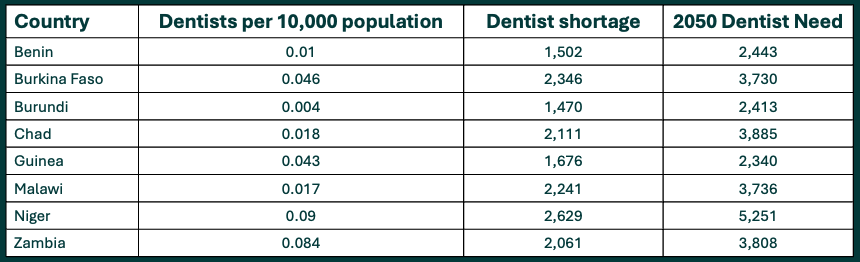
To understand the severity of this shortage, consider the United States, which has approximately 5.95 dentists per 10,000 people. In Guinea, that figure is just 0.043 dentists per 10,000 people, nearly 140 times fewer dentists relative to the population.
And the challenge is growing. As populations increase, countries already facing severe shortages will need to train thousands of additional oral health professionals simply to begin closing that gap.
But the challenge goes much deeper than a shortage of dentists.
To address the workforce crisis, countries must be able to train more dentists. That requires greater investment in the institutions and educators already working to meet this need.
Across Africa, 21 countries have no identified active dental school (3). In countries where dental schools do exist, many face significant constraints: too few qualified faculty, insufficient opportunities for supervised clinical training, limited simulation facilities, and inadequate equipment and infrastructure.
These are not minor obstacles. They directly affect how many students a dental school can train and whether those students can develop the clinical competence required for safe, independent practice.
Dental schools cannot simply increase enrollment without corresponding investment in the people, programs, and learning environments needed to support additional students.
This is the critical bottleneck: the demand for dental professionals is growing faster than the investment in the educational systems needed to train them.
Addressing this challenge means building on the expertise, commitment, and ongoing work of African dental schools, ensuring they have the resources and support to expand training opportunities and educate the workforce their countries urgently need.
Dental Care Meets Today’s Needs. Dental Education Builds Tomorrow’s Workforce.
Direct clinical care is essential. Outreach programs and visiting dental teams can provide treatment to patients who might otherwise go without. But these services cannot, on their own, resolve a country's long-term shortage of dental professionals.
Building more dental clinics is also essential, but a clinic cannot provide care without qualified professionals to staff it. Expanding access to treatment therefore requires investment in both healthcare infrastructure and the education systems that develop the workforce to sustain it.
Dental education offers a complementary, long-term solution.
When a dental school is supported to expand its educational programs, it can train more students who graduate, enter clinical practice, and serve communities throughout their careers. Some may pursue specialization, become educators, or take on leadership roles that strengthen the profession further.
And unlike a single clinical intervention, the benefits of investing in educational capacity can continue through successive cohorts of students.
This is the multiplier effect of dental education: an investment today can contribute to the development of dental professionals for generations to come.
The opportunity is not simply to train more dentists today, but to strengthen the systems that will continue training them tomorrow.
Investing in People Who Will Educate Others
At the heart of every dental school are its educators. They teach clinical skills, supervise students, assess competence, and prepare graduates for independent practice.
Investing in their development creates opportunities to expand both clinical expertise and educational capacity.
In Guinea, Dental Capacity supports Dr. Kallo as she pursues advanced training in pediatric dentistry. Her ambition extends beyond becoming a specialist.
As she explains:
"If we agree to be trained, we must at least train others. I want to become a professor of pediatric dentistry. I want to teach and give back to my country."
Dr. Kallo's vision reflects the commitment of African dental professionals who want to use their expertise to strengthen education in their home countries.
As a pediatric dentist, she hopes to provide specialized care to children. As an educator, she will also pass on her knowledge and skills to future dental professionals, extending the impact of her training well beyond her own clinical practice.
By investing in people who are committed to educating others, we can help create opportunities for knowledge and expertise to multiply.
Invest in People. Multiply Impact.
The shortage of dental professionals across Africa is significant, but so is the opportunity to address it.
Across the continent, educators and institutional leaders are already working to prepare the next generation of dentists and specialists. Greater investment in their people, programs, and learning environments can help expand that work and create lasting change.
At Dental Capacity, we work alongside African dental schools to support their priorities through faculty and program development, educational sponsorships, investment in clinical and simulation learning environments, and partnerships that strengthen dental education.
Our vision is quality dental education in every African country, supported by strong institutions capable of developing the oral health workforce their communities need.
Because when we invest in dental education, we're not just investing in the people learning today.
We're investing in the people they will teach, the patients they will treat, and the communities they will serve for generations to come.
Be Part of Lasting Change
Across Africa, dedicated educators and institutions are working to train the next generation of dental professionals. With greater investment, they can expand their reach and create opportunities for generations to come.
Together, we can help build a future where every African country has the capacity to educate its own dental professionals.
References
Gallagher, J.E. & Hutchinson, L. (2018). Analysis of human resources for oral health globally: Inequitable distribution. International Dental Journal, 68(3). doi: 10.1111/idj.12349.
World Health Organization. (2022). Oral health country profiles. Retrieved from: https://www.who.int/teams/noncommunicable-diseases/surveillance/data/oral-health-profiles
Gallagher et al. (2023). Oral health workforce in Africa: A scarce resource. International Journal of Environmental Research and Public Health, 20(3). doi: 10.3390/ijerph20032328.